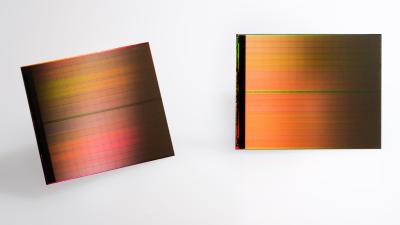
Mobile phones have taken another step towards becoming full-fledged pocket computers with an announcement by Micron and Intel. Get ready to carry even more of your digital life on your phone. More »
Micron touted its super-fast RealSSD drives with 250MBps speed a few months back, but now its demonstrated a tech that’ll blow them out of the water: 1GBps transfer rates. It’s a bit cheaty since it uses two SSDs for a total of 16 data channels to access the flash memory, but that does give it a 200,000 input/output operations per second speed. And that’s too fast for SATA II’s bandwidth cap, so Micron had to use PCI Express. It’s a technology demonstrator, but Micron apparently plans to commercialise it “soon”. [Electronista]
The inexorable march of solid-state drive technology continues forward with news from Micron Technology (one of the worlds leading semiconductor suppliers) that they’re going to produce SSD’s with a read speed of 250MBps. That’s more than twice the speed of the drives Samsung announced last month (90MBps.)
Micron and Intel have co-developed a new 8-gigabit SLC NAND chip, which has data-read speeds of 200 MB/second and write speeds of 100 MB/second: five times faster than previous SLC NANDs. The 50nm-process node devices are available as samples to OEMs now, with bulk manufacturing planned for late this year. This means that sometime soon we’ll have access to memory cards and SSDs for our cameras and laptops that are way speedier than existing ones, though you might expect insanely high prices for that speed hike—especially since SLC is expensive in the first place. [BusinessWire]
In addition to Micron’s traditional solid state drives announced today, they also showed off a concept for a SSD module that resembles RAM and would fit into a similar port. The design uses a SATA interface and is only 4 mm thick. Micron claims the advantages of such a design are the small size and the ability to line up multiple drives next to each other. In addition, this design requires no wires or mounting to the motherboard, reducing the risk of the SSD becoming disconnnected or loose inside a computer. While this product is nowhere near ready for market, Micron says they would need to work with an OEM or someone who can offer a compatible computer solution. [Micron] More »