This tiny puppy, named Hope, was born without front legs. You know what that means: it was time to create a robopuppy. Orthotist David Turnbill created a custom support for Hope using a couple of model aeroplane wheels, and each one of the “legs” can move up and down independently, allowing Hope to pivot and turn. If you were to say this is the most adorable thing ever, you might just be right. Hit the jump for a video of Hope getting fitted for her superlegs.
Cyberdine’s HAL Exoskeleton is more sophisticated than Human Universal Load Carrier (HULC), but HAL is only available to rent whereas HULC is available for purchase. Unlike HAL, the HULC is focused entirely on helping the user carry heavy loads—up to 90 kilos without breaking a sweat. It also helps to reduce oxygen consumption by up to 5-10% when walking.
Implanting a micro-camera directly into the eyeball may be a future solution for restoring sight to people with damaged vision, according to this patent application. The camera could be charged wirelessly, and communicate directly with a chip implanted at the back of the eye, so very little external hardware would be needed:
The long-awaited season premiere of Bionic Woman airs tonight at 9 PM, and I know what you’re thinking. When will my girlfriend get a nanotech immune system and deadly superstrength? I want a bionic babe in my living room, hopefully sitting on the wireless network, acting as a firewall and a Slingbox all at once! Who doesn’t want that, when you think about it? That’s why Laptop Magazine published a helpful guide to the science behind Bionic Woman, explaining when exactly you will have a girlfriend who can copy HD quality video off your DVR using ONLY HER MIND.
There are two reasons to watch this Fall’s remake of The Bionic Woman on NBC. One is Michelle Ryan, English actress and utter, utter hottie. The other is Katee Sackoff, Battlestar Galactica‘s chewer-upper of Cylon raiders —but we all know about her hotness already, so let’s focus on the new girl. There’s a video preview of the series and a poll about her after the jump.
A team at Vanderbilt University has come up with a prototype of a prosthetic arm powered by a miniature rocket motor that is as close to a bionic arm as you are going to get. “Our design does not have superhuman strength or capability, but it is closer in terms of function and power to a human arm than any previous prosthetic device that is self-powered and weighs about the same as a natural arm,” says Michael Goldfarb, the professor leading the research. You can see more from him in the video below.
Peter Houghton takes his metaphors a bit too seriously. The first lifetime recipient of a Jarvik 2000 ventricular assist device (i.e. an artificial heart) is grateful for the fact that he’s, you know, alive, but thinks he’s lost his emotions since getting the fake ticker. Dude, your emotions come from your brain, not from your heart, despite what all that poetry you’ve been reading says. One theory about his newfound lack of feelings is that his brain isn’t meant to be getting a steady stream of blood, which the Jarvik 2000 gives him, and is instead optimized for short bursts of it, like a real heart provides.
Since we last told you about Phonak hearing aids a year and a half ago, the Swiss company’s made strides to further advance the devices’ compact form factor and high-fidelity sound. The new Audéo Personal Communication Assistant (PCA) is available in two different styles and 15 color combinations. It’s discreetly tucked behind the ear and plugged into the ear canal with a transparent material that’s nearly invisible.
The gang at DARPA — you know, the ones working on invisible, shoot-through, self-healing armor — want to create kill-proof soldiers that have characteristics of animals that can survive in extreme conditions. They’re researching things like allowing soldiers to redirect oxygen demand throughout their bodies to allow them to stay underwater for hours. Dammit, DARPA, didn’t you see the Bourne movies? This isn’t going to end well for you.
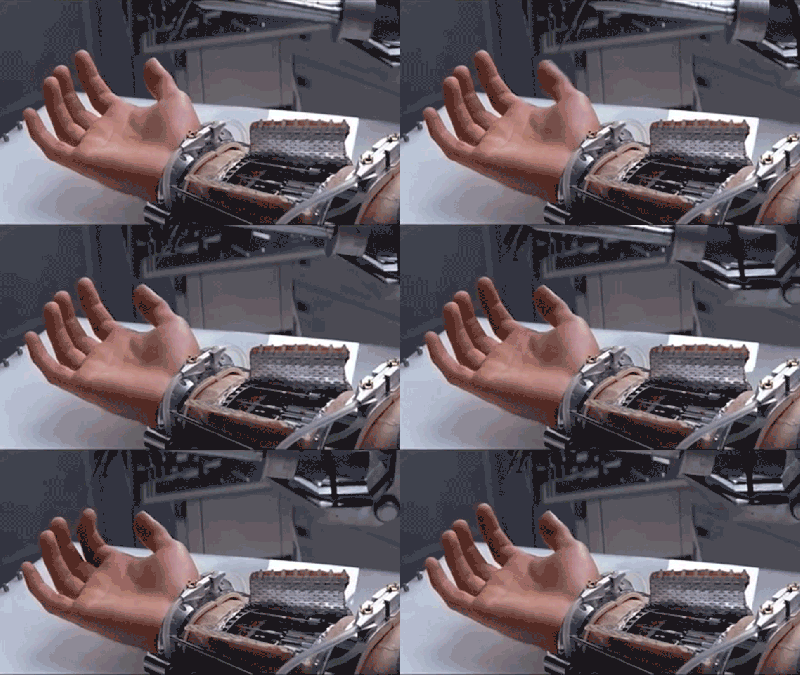
When we die and are reincarnated as robots, we will all have Shadow Hands. An advanced limb developed mostly for researchers, the Shadow Hand provides 24 unique movements, or 1:1 movement to a real human hand. These movements are spurred by 40 independent muscles, which are extremely cool.