
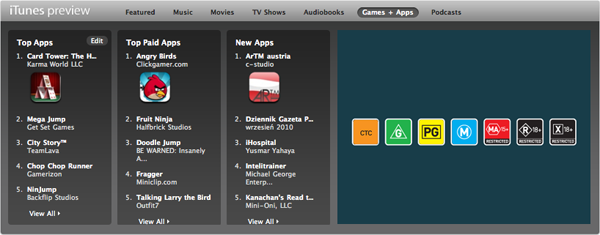
 There’s currently (at least one) pretty big flaw in the way classification works in Australia. Despite the fact that all video games are by law required to go through classification, the relatively recent explosion of mobile applications has meant that developers could release games to the public without classification through mobile app stores without needing to go through the classification board. But all that is officially about to change.
Ben Grubb at the SMH spoke to Home Affairs Minister Brendan O’Connor following the most recent SCAG meeting, and he confirmed that he was looking to change classification legislation to incorporate mobile apps. On the upside, the approach the government hopes to take is at least a lot more manageable than forcing developers around the world to submit their app to the classification board – In the summary of decisions from the SCAG meeting, the Attorneys General decided that mobile games would be “treated similarly to other online content, rather than stand alone computer games.” In other words, only apps that received complaints would be subjected to classification.
O’Connor confessed to Grubb that forcing all apps to undergo classification would place unbearable strain on the classification board:
“Theoretically the board must classify every application, but you would need an army, literally an army of classifiers to get through the applications because the growth has been exponential and for that reason we’re going … to a complaint-based approach.”
Even more interesting is how these changes will impact players like Apple and Google. O’Connor believes that after a game has been classified (and not refused classification), distributors of the app would need to display the classification and where necessary restrict access to purchasing highly classified programs.
With the AGs essentially on hold until after the NSW election, the next chance for this to be agreed upon will be at the July SCAG meeting, and only after it gets the unanimous nod from Attorneys General countrywide would O’Connor be able to submit the changes to legislation.
As far as solutions go, this is probably a best case scenario for classifying mobile games. But it will be interesting to see how this works with Apple’s own classifications systems, which are notoriously unbalanced as it is.
[SMH]