stars
Design
DIY Star Ceiling Brings The Universe Inside
12:40AM Mark Wilson | I thought that I was pretty hot shit when I climbed on a stool and double-sided-taped glowing stars to my ceiling, but their waning green light never captured the night sky like DIY fibre optics. More »
Science
The Aliens Of Star Iota Horologii Are Just Watching Captain Kangaroo
12:30AM Adam Frucci | When our broadcasts leave Earth, they slowly travel into space. There is, however, a sizable delay between what we watch and what distant aliens watch. This convenient chart shows us what TV various stars are receiving today. [AbstruseGoose via TDW] More »
Science
Hubble Discovers Star Torpedoes Ripping Through Space
12:53AM Jesus Diaz | They are stellar interlopers: Stars that instead of rotating quietly around a galaxy, rip their way across interstellar gas creating bow shocks, like giant proton torpedoes. These are a new kind, according to the JPL: More »
Science
Man-Made Stars to Create Thermonuclear Reactions: Not as Scary as the Large Hadron Collider
1:40PM Andi Wang | To further the advancement of fusion energy, national security, and a leadership in basic science and technology, the National Ignition Facility is attempting to create thermonuclear reactions by producing their own man-made star. More »
Science
Celestial Globe Shows Earth During Day, Star Map at Night
3:30AM Mark Wilson | When I eventually decide that it’s time to manufacture or purchase my offspring, needless to say, they will be outfitted with the best tech I can force onto them, including this great day/night globe. More »
Cameras
Refrigerated Digital Camera Used to Take Amazing Space Pictures
8:30AM Jesus Diaz | Greg Parker is a professor of electronics at Southampton University. He’s also a wizard. Like his co-author Noel Carboni. Real wizards, capable of obtaining images rivaling the best of Hubble’s using less than $US15,000 in equipment and more patience than any money in the world could buy. Their magic: A refrigerated CCD chip inside a special digital camera, a manually-operated dome, and some smart post processing in Photoshop. More »
Science
Astronomers Take FIRST EVER Pics Of Other Planetary Systems
12:30PM Elaine Chow | Huge astronomy news! For the first time EVER, galaxy researchers have taken pictures of planets orbiting a sun-star, much like our own. The first, taken by the much beloved Hubble Telescope, shows a planet orbiting the bright southern star Fomalhaut, located 25 light-years away in the constellation Piscis Australis. The second picture, snapped by upstaging Hawaiian observatories Gemini and Keck, shows two young planets orbiting a completely different star located 130 light-years from us! Take that Hubble! But I warn you—like the ultrasounds your friends show you of their three-month old fetus—these pictures wow mostly because of what they are, not because of what they look like. More »
Science
Scientists Record Music of Stars, Spookily Like a Star Trek Sound Effect
1:15AM Kit Eaton | A group of astronomers have taken the “Music of the Spheres” quite literally, and have recorded the sound of three stars that’re similar to our Sun. The technique, dubbed stellar seismology, lets scientists get some idea about what’s going on in the inner structure of the stars. This research was carried out using France’s Corot space telescope, and the rhythmic beating in each “tune” shows that the stars are pulsing. But that clever and interesting science is not the eerie part. This is the eerie part: as you listen to the recordings, you’ll be unavoidably reminded of the sound effects from the original series of Star Trek. More »
Science
NASA Shows Off Fireworks In Space
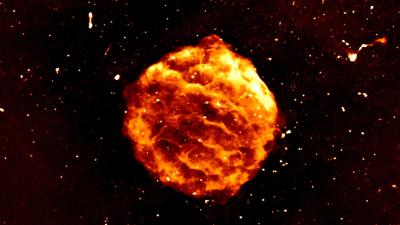
12:00AM Gizmodo US Edition | Before we completely bid adieu to our nation’s birthday, we here at Gizmodo would like to give one more shout out to the fourth of July. Seems like even the stars in the sky can’t resist putting up a display for good ol’ American freedom. These red-white-and-blue pictures of Supernova remnant SN 1006 are what’s left over from a star explosion first observed by humans in year 1006. More »
Science