optics

Networks

USAF’s Ultrawideband Laser Networks

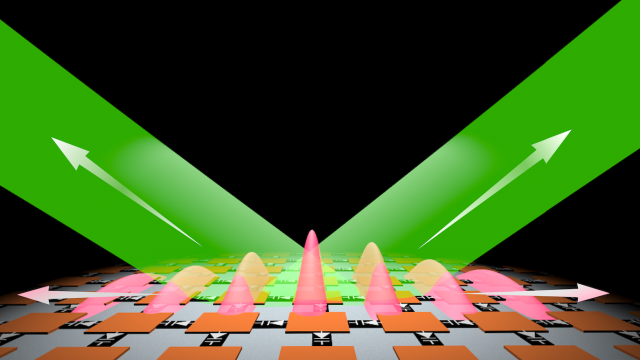
7:21AM Jesus Diaz | The US Air Force is not only experimenting with lasers to kill missiles. They are now using them to transmit data from planes and drones at 35km and enabling quantum encryption. They did it with adaptive optics. More »
Hardware

Optical Gaming Implants: Vision Of The Future From ATI And XFX

5:44PM Danny Allen | I love fake ads from the future: like the satirical spots from Robocop and Total Recall, or the Veridian Dynamics openers in Better Off Ted. These ads for “Eyefinity” gaming implants aren’t as clever, but they’re still a fun watch: More »
Cameras

The 3 DSLR Lenses You Need (and 2 More You’ll Crave)

3:00AM Wilson Rothman | This goes out to people who bought or want an entry-level DSLR, and wonder what’s the deal with interchangeable lenses. You really gonna buy that extra glass? It’s a beginner’s guide to growing as a photographer, preferably without going broke. More »
Cameras

Camera Sees The World Through Human Eyes

12:30PM Rosa Golijan | With the Human Eye Camera you won’t need a DIY lobotomy to see how the world would look without your brain flattening the images. With three arrangeable sensors, it’s as if your eyes had RAW output. [Four Fifths Design]
Gadgets

Smith Optics I/OS Interchangeable Snow Goggles: Lightning Review

1:49PM Brian Lam | The Gadget: Rimless goggles with a locking lens plate for switching up the glass for sunny or cloudy days. A follow up to their I/O googles, but with improved foam sealing and shape. More »
Science

Scientist Designs Nanoparticle Optics That Self-Assemble

12:10AM Kit Eaton | Nanoparticles that self-assemble into complex optical structures sounds like an early ingredient in a future Robot Uprising recipe, but the science team at University of California, Berkeley thinks they’ll be useful for nicely tame things. The self-assembly of the nanoparticle silver crystals can be controlled to produce different nano “devices” and it’s a a neat way of putting together nanotech that is more typically produced top-down by lithography. The devices can be as diverse as colour-changing paint, optical computer elements, and ultrasensitive chemical sensors. More »
Science

Sound Wave-Driven Liquid Lenses Good For Lightweight Future Phones, UAVs

8:12PM Kit Eaton | Scientists at Rensselaer Polytechnic Institute have come up with this freaky adaptive liquid-lens that can capture 250 in-focus images per second. It’s essentially droplets of water in a pair, trapped in a chamber and driven by a high-frequency sound wave to oscillate. More »
Weapons

DARPA Developing Scopes That Use Heat Haze to Achieve Super Resolution

6:10AM Sean Fallon | Yes, DARPA does have a reputation for coming up with some seriously far-fetched gadgets, but their Super-Resolution Vision System (SRVS) is not one of them. This project challenges designers to come up with an optics system that utilises heat haze to see further and clearer than ever before. Basically, it takes advantage of an atmospheric phenomenon that occurs whereby images can be magnified for fleeting moments behind the haze. More »
Science

Drawings of Early Microscopes Show Artistry in the Pursuit of Science

7:45AM Gizmodo US Edition | Ah, where would science be if not for the contributions of the humble microscope? Did you know that the development of the world’s first microscope began in 11th century Iraq, when scientist and polymath Ibn al-Haytham recorded all sorts of data about lenses, binocular vision, mirrors and observable properties of light his The Book of Optics? That would make this pioneering technology more than a thousand years old. BibliOdyssey has amassed a great collection of drawings of pre-20th century microscopes and some of them look more like art pieces than instruments of science. Check out my favourites: [Bibliodyssey via MAKE] More »
Science

New Flexible Image Sensors Could Enable Eyeball-Cams, More Realistic Cyborgs

12:30PM John Mahoney | Traditional camera lenses have to have beefier optics to make up for the fact that the sensor is flat–but one reason why the human eye is such an efficient little cam at (576 megapixels! ISO 800!) is because our image sensors (err, retinas) are rounder to better capture the light transmitted by the lens on the other side of the sphere. Researchers at Northwestern and U. Chicago have found a way to create a traditional photo sensor that flexes without breaking, which means your cyborg glass eye of the future will be all the more lifelike. More »