Top Stories
Regulars
Father-Daughter Team Use 3D Printer To Create Nanobot Art
Jeff and Ashley Sierzenga recently took it upon themselves to bring to life the flesh-eating nanobots from Jeff Carlson’s best-selling series Plague Year. Here you can see their entire project, from schematics to the final model.
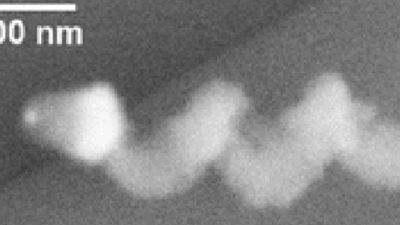
This Is What A Spider Nanobot Really Looks Like
This Is The Future Of The Fight Against Cancer
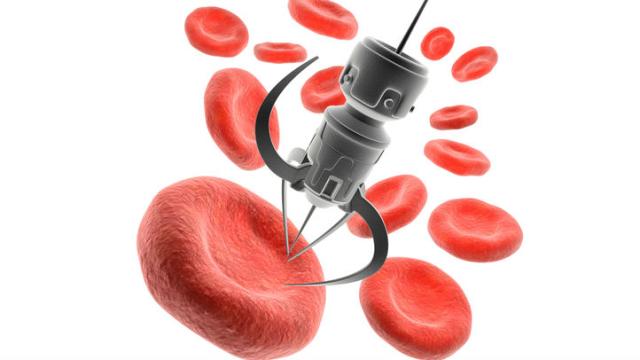
Look close. You may be staring at the end of cancer. Those tiny black dots are nanobots delivering a lethal blow to a cancerous cell, effectively killing it. The first trial on humans have been a success, with no side-effects:
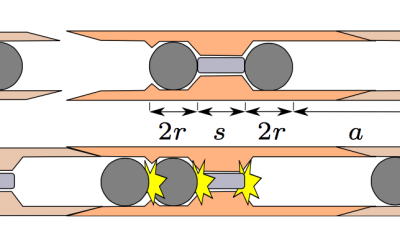
1:35,000 Scale Working Model Train Might Be The World’s Smallest
David Smith believes he has build the world’s smallest working train, and based on the images and video I wouldn’t doubt that claim. Apparently, it is 35,000 times smaller than the real deal.
Nanobot Uses Bacteria Swarm for Propulsion
Canadian researcher Sylvain Martel has developed a ultra tiny machine that can be propelled and steered through a swarm of 3,000 bacteria.
Flying Nanobot Gives Wings to Imminent Grey Goo Doomsday Scenario
Researchers at the University of Waterloo in Ontario, seemingly oblivious to the fact that technology is exponentially outpacing our ability to keep up with it, have created a new breed of levitating nano-machines.
Robotic Insects Could Build Human Habitats on Mars Before We Arrive
Move over bristlebot: Europe’s I-SWARM program is developing some similarly small but much smarter micro ‘bots that could be used to build human colonies on Mars. The tiny machines would be dispersed in huge numbers, working automatically and independently, and also collaborating together to form larger compound ‘bots able to do physical stuff like moving rocks out of the way.
Researchers Begin Work on Building Real Life (Microscopic) Transformers
Researchers at Carnegie Mellon University have begun work on creating tiny groups of robots that utilise electromagnetic forces to alter their shape and function. Ultimately, the team hopes to build a large number of microscopic robots that are able to metamorphose into any conceivable shape. This would be done by applying a charge to the nanobots, which would form different structures based on how, or where, that charge is applied. The concept is not too dissimilar to the material that was shown to be used for Batman’s cape in Batman Begins. That similarity makes this research instantly awesome.
Sperm Could Be the Slave Drivers of the Nanobot Future
Scientists are investigating the possibility of using the “tiny assembly line that powers the whip-like tail of sperm” to send medical nanobots racing throughout the body. In order to work, these devices would have to be made from biomedical components —and at that size, “biology would provide the best functional motors.” This approach seems bizarre, but apparently it could help solve the problem of supplying energy to thousands of minuscule internal devices that can fight or ward off disease. How long it will be before these spermbot slave drivers become a reality is anyone’s guess. [MSNBC]
GM OnStar Ant Vehicle Uses Nanobots, Artificial Muscles
The GM OnStar Ant vehicle uses a Nanorb wheel system, “independent robots that can arrange themselves in any configuration” along with artificial muscles called “electro-active polymer actuators” to change the position of its body panels. It’s probably made of adamantium too and it can transform itself faster than you can say “Optimus Prime” into any kind of vehicle, a shelter and, I bet, even in a killer ninja robot if programmed correctly. Fortunately for humans, is just a concept for the Robocar 2057 Design Challenge. [GM OnStar Ant]