flexible

Screens

Liquid OLED Tech Could Lead To More Reliable, More Flexible Displays

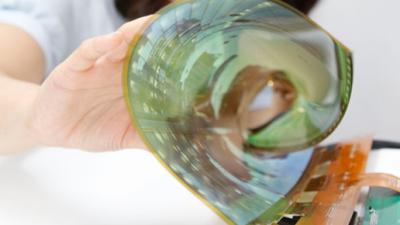
8:00AM Jack Loftus | We’ve already told you that legitimate flexible OLED displays really are coming now, but thanks to some Japanese researchers they could be more reliable—and flexible!—than we first imagined. More »
Hardware

Let’s Speculate: What Could Flexible Memory Be Used for?

8:00AM Dan Nosowitz | Researchers have developed a lightweight, mostly transparent, and quite flexible memory chip. It sounds cool, but then I think: What possible advantages could flexible memory have? Help me out, commenters. More »
Screens

Flexible OLED Screens Are Really Coming Now

3:20AM Matt Buchanan | Making a regular OLED display is, like, hard. So you can imagine making a flexible one just totally sucks. Arizona State’s Flexible Display Centre and Universal Display Corporation have a new way to make bendy OLED screens that might make mass production possible in just a few years. More »
Screens

University Claims to Have Developed World’s First Flexible Touchscreen Display

2:40PM Gizmodo US Edition | ASU’s Flexibile Display Centre and military partners have developed the very first display with a flexible touchscreen. Mainly designed for military applications, the screen is made out of glass strong enough to withstand the battlefield. More »
Screens

OLED Gauntlet Fulfils Our Techno Hero Fantasies

4:30AM Mark Wilson | Universal Display Corporation’s flexible OLED armband may be a bit bulky today, but just think, in a few years it’ll be bionically embedded in your arm to control your rocket pack and robo dog. More »
Screens

Wrist-Worn, Flexible OLED Out in the Wild

2:30AM Sean Fallon | The Universal Display Corporation (UDC) have themselves a wrist-worn, flexible OLED prototype that they built with support from the US Department of Defence. More »
Science

Fuel Cells To Go Bendy, Fit Inside Gadget Corners

11:15PM Kit Eaton | Fuel cell tech is literally just around the corner from being inside many of our gadgets, and with this new design it could allow for some unusually-shaped gizmos. A company called MyFC is showing these bendy, flexible hydrogen-powered cells that can be draped over the interior curved surfaces of a gadget in a way that is tricky with current battery tech. The FuelCellSticker devices are just 3mm thick and weigh only 5.7 grams, and can put out 0.5V at 0.9W, though you’d stack them for more volts. There’s also a more conventional-shaped model, and the company is starting to make them to order. Clever stuff. [Crunchgear] More »
Screens

Flexible OLED Display is .05mm Thick, Flaps Around in the Wind

8:27PM John Herrman | Samsung has unveiled an ultra-thin ‘flapping’ OLED screen at FPD International 2008, demonstrating the flexibility of the display by letting it bend and flutter in the wind. At a paper-thin .05mm, the 4-inch screen is still able to create an image of 480×272 pixels, with a 100,000:1 contrast ratio and 100% reproduction of the NTSC colour gamut, which is in line with most new flat panel screens on the market. If this all sounds familiar, it’s because Sony made a lot of the same claims a few weeks ago — but they didn’t have the balls to let their screen go all flippy-floppy in public.
Screens

Sony’s Flexible 11-Inch OLED Screen is 0.3 Millimeters Thick, Wraps TV Around Your Finger

12:45AM John Mahoney | Aside from allowing for ridiculous contrast ratios and eye-exploding colour saturation, OLEDs can also be thin enough to be flexible, as Sony is demonstrating here with this crazy 0.3-millimeter-thick concept display at CEATEC. We’ve seen flexible OLED screens before, but 11-inches is a significant step forward. What’s in store when this concept moves into reality? Wearable TV jackets? Flexible laptop screens? TV blankets? Boggling. More »
Computers

Scientist Predicts Flexible Computers As Shape Of Things to Come

2:00AM Gizmodo US Edition | We’ve been talking about next-gen display technology like e-paper for ages, but professor Roel Vertegaal thinks we’re not thinking about future computing flexibly enough. He’s convinced that “non-planar” computing devices with screens in almost any shape will one day be ubiquitous, and is busy building prototypes in his lab. More »