electrons
-

Do You Follow Terrence Howard’s Wild Theory of Hydrogen Propulsion?

You and I know Terrence Howard as the Academy Award-nominated star of Hustle & Flow, or Empire, or a slew of other movies and TV shows over a long, successful acting career. Turns out, Howard also has a strong interest in chemical engineering, specifically as it pertains to hydrogen propulsion. Recently, Howard visited Uganda to…
-
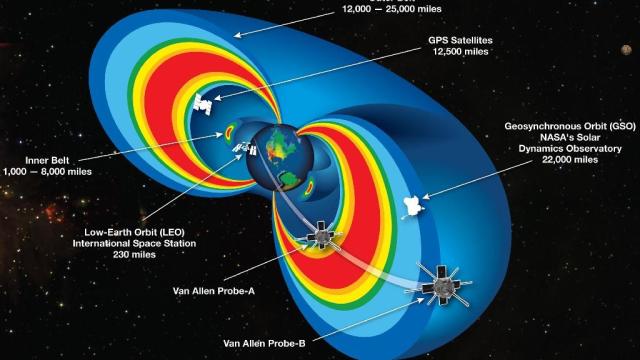
New Information On The Invisible Belt That Saves Earth From Radiation
A NASA-led study of the Van Allen radiation belts has uncovered new information about the invisible “shield” that keeps harmful ultrarelativistic electrons from the Earth. Just last year, the probes reported the existence of a new, previously-unknown third belt thousands of kilometres above the Earth.

-

Why Is Glass Transparent?
We all take for granted the fact that glass is transparent. But stop and think about it for a second: how can something so bulky and solid be so easy to see through?

-

Scientists Manipulate Electrons Into Material Never Seen On Earth
Stanford scientists have created designer electrons that behave as if they were exposed to a magnetic field of 60 Tesla — a force 30 per cent stronger than anything ever sustained on Earth. The work could lead to a revolution in the materials that make everything from video displays to aeroplanes to mobile phones.