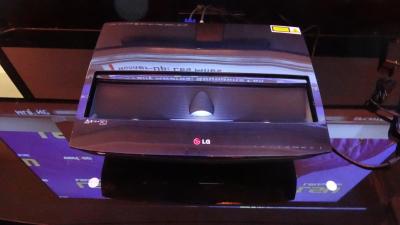
Yes, that’s sub-$1500 local money. ViewSonic’s new PJD6251 (model number as sexy as ever) is a portable 120Hz 3D-ready projector, weighing in at 2.9kg. It isn’t necessarily your number one choice for home theatre extravagance, but for the money this makes for a nice small biz or random fun option. More »
If you’ve seen one of those tiny pico projectors, chances are, Texas Instruments’ DLP tech is inside. And their latest version, the mHD DLP Pico, may be the first to squeeze into a mobile phone that’s humiliating to use. More »
If you owned a TV with a screen bigger than 40 inches before the year 2000, chances are it was a rear projection model. And chances are it took up most of your loungeroom. More »
Mitsubishi just announced a bunch of new DLPs and LCDs. But the most interesting is, by far, an 82-inch DLP for $US4200 that’s equipped with “3D-ready viewing technology.”
Despite this month looking like the kick-off to the next Great Depression, a bunch of you are probably still planning to (finally) hop on the HDTV bandwagon. And all things considered, that’s not a totally stupid move. A great HDTV—one that will blow away the standard definition puke you’ve been watching for years—can be had for a damn good price. But if you’re planning on checking out HDTVs tomorrow (or ever), read this first:
The Economist has a great piece about researchers at the Chinese Academy of Sciences have developed a digital cinema projector that uses lasers as the main display technology. In doing so, these projectors are able to display a staggering 80 percent of the colour range visible to the human eye. Previously, the 60 percent range that 35mm film offered was considered the benchmark for other projectors and displays to measure themselves up against.
The NTT DoCoMo prototype phone shown in the video above has an embedded DLP projector, presumably using an LED light source in order to project a respectable 20- to 25-in. video image on the wall a few feet away. The downside, as you can hear from the dude asking questions (AOL Switched’s Tom Samiljan if I’m not mistaken) is that the phone is large, or at least small but strapped to a real brick of a projector. I guess we’re supposed to admire the image, and wait for the actual mini-projector technology to catch up. [TechPertPanel - YouTube]
newVideoPlayer("/fingertouch.flv", 475, 376,""); Rear-projection may be deader than dead as far as the biggies are concerned, but the folks at nLighten are intent to squeeze a bit more life out of these 72-inch 1080p DLP sets by sticking an infrared camera inside next to the light source that detects cursor points from an IR-tipped pen, allowing for a simple (no multitouch) touchscreen interface. It can act as a standard Windows mouse allowing for 1080p touchscreen Google Earth, or any other app.
With the ever-falling prices of flat panel LCD and plasma displays, it was only a matter of time before the rear projection television died a tragic death. Since 2007, their sales in the market under 60 inches have dropped by 32%, meaning that 84% of the rear projections sold today are now 60 inches or over. From what we understand, that includes newer DLP technology as well. Another interesting metric: Just 2 of the 40 HDTVs reviewed by CNet this year have been rear projections. But if you’ve got the space and don’t mind the style, their quality per dollar quotient is still undeniably good. [Crave] [image]