cells
Science
So Just How Small Is A Ribosome, Anyways?
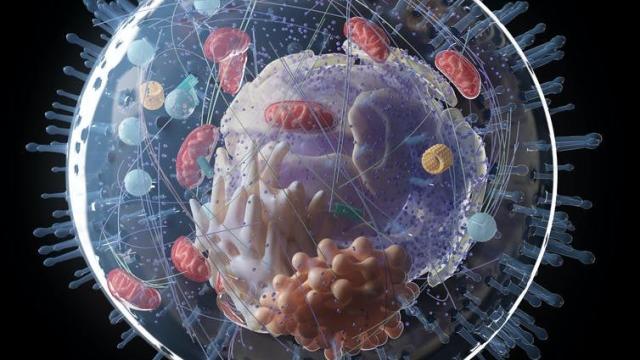
2:40AM Adam Frucci | This incredible interactive visualiser of cell size from the University of Utah is a must see, allowing you to zoom in from a coffee bean down to a carbon atom. Prepare to have your mind blown. [GSLC via DailyWhat]
Games
PS3 Slim Contains The 45nm Cell Processor
12:41AM Mark Wilson | Everyone assumed it because of the Slim’s power savings, but it’s been confirmed that the Cell has been shrunk to 45nm (down from 65nm). [Yahoo Tech via CrunchGear] More »
Robots
9:45PM John Herrman | All those fly-catchers—the sticky ones, the glowing ones, the zappy ones—seem like such a waste. Surely there’s something to do with all those fly carcasses, aside from cringing at them. Enter James Auger and Jimmy Loizeau—insect nemeses. More »
Fly-Powered Gadgets Turn You Into A Terrifying Supervillain (To Insects)
9:45PM John Herrman | All those fly-catchers—the sticky ones, the glowing ones, the zappy ones—seem like such a waste. Surely there’s something to do with all those fly carcasses, aside from cringing at them. Enter James Auger and Jimmy Loizeau—insect nemeses. More »
Science
Scientists Grow Doll Out of Living Cells, Complex Organisms Next
5:30PM Elaine Chow | Researchers at the University of Tokyo created a 5mm tall doll composed of living cells, in an experiment to create 3D living biological structures. It’s cute and kinda gross at the same time. More »
Science
Scientists Build Computer Circuit From Brain Cells
1:00AM Sean Fallon | Scientists at the Weizmann Institute of Science in Rehovot, Israel have managed to build reliable logic gates out of neurons instead of wires. The process actually sounds fairly simple: a glass plate is coated with cell repellent then etched with the desired circuit pattern. The pattern itself is coated with a cell-friendly adhesive which forces the cells to grow only in the scratched areas. Because these scratched paths are so thin, the neurons grow in one direction only—forming straight connections around the circuit. This method has been used to replicate an AND logic gate that only produces output when it receives two inputs. More »
Science
Scientists Make Living Building Blocks: Self-Assembling Artificial Tissue in Future
11:15PM Kit Eaton | A team at MIT and Harvard Medical School has worked out how to cast bricks of artificial tissue into different shapes, and then get them to assemble automatically. The “living Lego bricks” are cast of polyethylene glycol—a biocompatible polymer—and solidified with light exposure. The self-assembling part happens when the bricks absorb water and are then agitated in a bath of mineral oil: The oil/water mix means the bricks move around and can be fixed when they’re in the right place with more light (as shown in the picture here, rod-shaped bricks in red stuck to a central green-stained piece). More »
Gadgets