
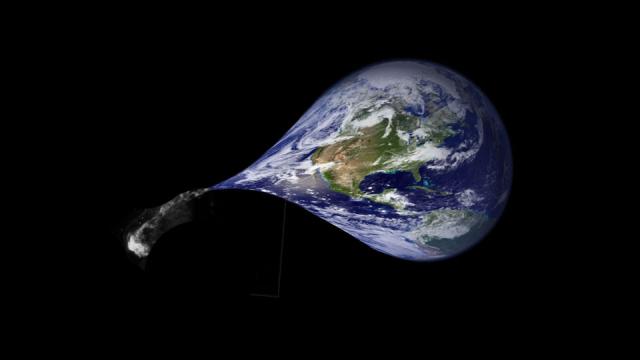
Earth is getting 50,000 tonnes lighter every year, even while 40,000 tonnes of space dust fall onto our planet’s surface during the same period. So, why are we losing so much weight? You will be surprised.
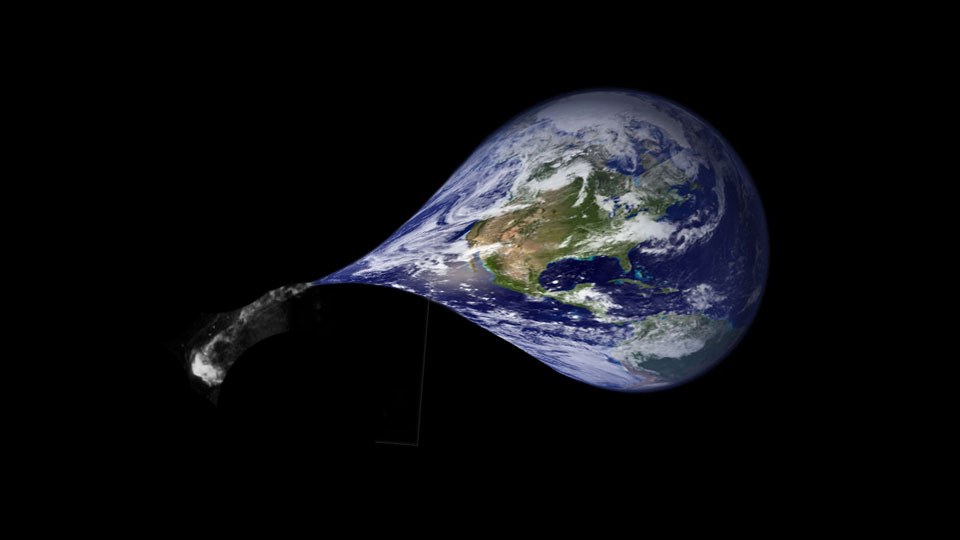
At least, I never considered this and I was surprised to hear the reasoning in More or Less, a BBC Radio 4 program about statistics and numbers. According to Dr Chris Smith and Cambridge University physicist Dave Ansel’s calculations, despite those 40,000 tonnes of space dust that become part of our planet every year, Earth loses 50,000 tonnes of mass. Is it because we keep launching rockets? No. These are their back-of-the-napkin calculations:
Adding weight
• Earth gains about 40,000 tonnes of dust every year, the remnants of the formation of the solar system, which are attracted by our gravity and become part of the matter in our planet. Our planet is actually made from all that starstuff.
• NASA says that Earth gains about 160 tonnes of matter a year because the global temperature is going up: “If we are adding energy to the system, the mass must go up.” Oh, those crazy thermodynamics.
No effect
• Of course, having more people or building stuff doesn’t add any mass to the planet. Humans and things are made with the matter that is already in the planet. It’s just being transformed.
• Most of the rockets and satellites that we launch to Earth orbit eventually fall down back to Earth, so no real effect here.
Losing weight
• Earth’s core loses energy over time. It’s like a giant nuclear reactor that burns fuel. Less energy means less mass. 16 tonnes of that are gone every year. Not much.
• And here’s the big mass loss: about 95,000 tonnes of hydrogen and 1,600 tones of helium escape Earth every year. They are too light for gravity to keep them around, so they get lost. Gone into space.
The result: the rough estimate is -50,000 tonnes every year. Which is about 0.000000000000001% less mass every year.
Should we be worried about Earth disappearing into thin air? No, you shouldn’t. And you shouldn’t worry about losing hydrogen. There’s plenty and it will take trillions of years to deplete it.
Helium, on the other hand, is a different matter. It represents 0.00052% of the volume in our atmosphere, but it’s mainly harvested from natural gas using a process called fractional distillation. Helium is becoming scarce in our planet. In fact, Cornell University physicist and Nobel Prize-winner Robert Richardson once said that each floating party balloon should have a $US100 price tag, who campaigned against the US Government decision to sell the country’s helium stockpile by 2015 to keep prices down.
He’s probably right, considering that it is crucial for devices like MRI scanners, where it is used for cooling superconducting magnets and growing silicon and germanium crystals as well as the production of titanium and zirconium. [Download the program here (5MB)]