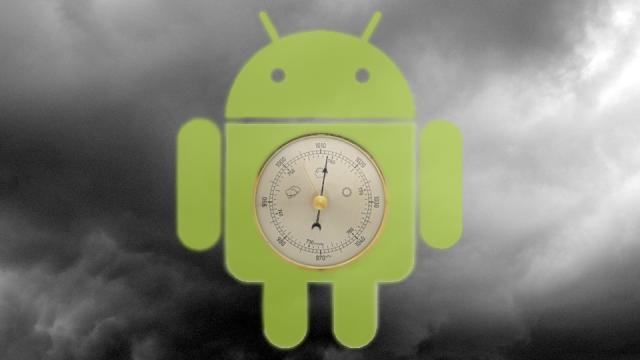
Why The Barometer Is Android’s New Trump Card

Samsung’s Galaxy Nexus is the most high-profile device to date to feature a barometer amongst its guts. Seems strange that a atmospheric pressure measurement would be crammed in a device where space is supremely valuable, right? Except it’s actually wonderful.

Traditionally, barometers have been used to detect — and predict — short term changes in weather. Measured drops in pressure indicate rain is on the way. Sharply rising pressure signals clearer skies are ahead. But surely, Samsung and Google didn’t conspire on this just to make more accurate weather predictions, right? Actually, maybe. But that’s just part of it.

Weather Center

What if the barometer was used not to provide personalised weather predictions, but to provide data to a crowdsourced weather network for the common good of commuters/travellers/pedestrians everywhere? Imagine having a server interpret thousands of pressure readings in a small radius to give you very specific, very precise weather forecasts.

Presumably, such an idea would work best in a moderate-to-dense population area where there was a pretty constant and solid mesh net of barometric readings. How many phones would be required in a given area to accomplish this? According to the New York Times, the most prominent weather app that employs crowdsourced data is Weather Underground. They currently pull from 20,000 stations across the country. With a barometer in every phone? They could be pulling from 20,000 barometric sensors in a single neighbourhood or city.

There’s also an app in the Android Marketplace called pressureNet, which currently logs barometric data from Motorola Xooms (which also have the sensor) and plots the info on a map. Once they have more users and more data, they promise to use the data to provide weather insights. But given that the app is all of 10 days old, its usefulness remains to be seen.

There are privacy concerns at play here — when aren’t there? Such an app would have to collect your location along with the barometric data for it to matter at all. And in all likelihood, Google would have access to this data, which rightfully worries some.

But for others, location is exactly why a barometer will be most welcome.

Navigation 2.0

The other popular use for barometers? Navigation. GPS is great when you have a clear shot of the sky, but when weather is bad, or you’re in the city of a cramped metropolis, things get a bit dicey. That’s why accelerometers, Wi-Fi chips and, yes, the barometer, have become increasingly useful in navigation, able to help assist the GPS in determining location.

The barometer uses its atmospheric pressure readings to determine your altitude and more accurately determine how quickly you’re moving through an area. Considering that smartphones have all but made the standalone GPS navigation device obsolete — and that Android houses one of the better navigation apps around — it would make sense that Google would want to put time and effort into making that technology even better.

Outdoorsy-type apps could become more useful to hikers and adventurers for whom topography matters.

The Unforeseen Awesome

Here’s the other thing: once devs get their hands on Ice Cream Sandwich and its barometric possibilities, who knows what they might come up with? The most obvious secondary benefit might be to gaming developers, who could use the altitude measuring to improve control schemes in games. But what’s most exciting are the possibilities we can’t even dream of yet. And it’s something no one else has right now.

So yes, the introduction of a barometer may have made a few eyes roll. But at the very least it could revolutionise the way we think of weather predictions and navigation. And at most? We’ll find out soon enough.

Discuss

(23 Comments)
  • [–]

    Daniel

    Thursday, October 20, 2011 at 7:24 AM

    They would want to have some good error checking protocols in place. Pressures inside buildings and in some work environments are going to give false readings. Maybe it’ll be based on whether your GPS has a view of the sky… even then…

  • [–]

    Daniel

    Thursday, October 20, 2011 at 7:25 AM

    They would want to have some good error checking protocols in place. Pressures inside buildings and in some work environments are going to give false readings for weather prediction. Maybe it’ll be based on whether your GPS has a view of the sky… even then…

  • [–]

    anth

    Thursday, October 20, 2011 at 8:36 AM

    lets fast forward to next year june july apple releases the long awaited iphone 5 and one of its major features will be the barometer

    • [–]

      Antonia

      Thursday, October 20, 2011 at 9:27 AM

      And of course Apple will then sue anyone else that has or had the temerity to include a barometer in their product.

      • [–]

        Matt

        Thursday, October 20, 2011 at 9:52 AM

        They won’t sue – but it’ll be “magical & revolutionary” and all the sheep will praise it like it’s never been done before (facetime anyone??)

        • [–]

          Matt

          Thursday, October 20, 2011 at 10:57 AM

          “…and one more thing” – All iPhones now come with a Barometer. Apple will monitor the Barometric pressure from EVERY iPhone and store it on the cloud. Then, no matter where you are, our personalised weather App will give you predicted weather within 5C of the actual weather. We call this iWeather.

    • [–]

      Nads

      Thursday, October 20, 2011 at 11:40 AM

      lets see… Apple bangs a compass into the 3GS, then all Andriod phones come out with compasses after. Apple puts a 6 axis gyroscope in the iPhone 4 after that all the other phones have gyroscopes.

      Having a barometer in a smart phone just seems stupid to me. considering you can get actual accurate weather reports through your phone.

      • [–]

        Cel

        Tuesday, April 17, 2012 at 5:24 PM

        I’m considering switching to one of these phones specifically for the barometer. It allows a faster GPS lock. With the gaggle and xcsoar applications, it can do the job of a $2000 GPS/Variometer/Altimiter for flying.

  • [–]

    Bots

    Thursday, October 20, 2011 at 9:40 AM

    Best feature ever!

  • [–]

    TSH

    Thursday, October 20, 2011 at 10:23 AM

    My first thought: yet another battery drain. I appreciate the thought, and crowdsourcing weather forecasting data is a great idea, but surely people will turn the feature off when they discover their battery is half dead by lunchtime.

  • [–]

    Penmonicus

    Thursday, October 20, 2011 at 10:54 AM

    I really like the “crowdcourcing barometric pressure” thing, but like someone else said – if more than half of the data you’re getting is from people who are indoors, won’t it be inaccurate?

  • [–]

    Troy

    Thursday, October 20, 2011 at 11:01 AM

    What about phones in pockets or bags? Surely they wouldn’t be able to give accurate/even-slightly-useful information

    • [–]

      Andrew

      Thursday, October 20, 2011 at 12:44 PM

      I don’t see that the barometric pressure in a handbag is going to be that much different from what’s outside, unless you have a sealed & pressurised handbag :P

  • [–]

    Nate

    Thursday, October 20, 2011 at 1:03 PM

    LOL at the comment about the fact you can get “accurate weather reports through your phone”… 99% of the reports that you currently get through accuweather and google are quite a fair way out and far from the correct weather. WeatherUnderground is pretty close as it sources info from local PWS.

    I run one of those PWS but baro pressure is only part of the picture. Reading and interperating the baro alone in different elevations and such is a challenging task. For example mean sea level hPa is 1013.2hPa and just going into the outer suburbs of Adelaide is around 460m above sea level.. and thats a massive 18hPa difference from which the phone will read 1029.9 hPa. This makes it difficult to predict weather using that alone. Which is where the GPS will be vital in getting an accurate reading.

    The idea is great and good luck to them but I can see allot of potential room for error in the theory.

    • [–]

      Nate

      Thursday, October 20, 2011 at 1:06 PM

      And as to the people saying about the presurised readings of buildings.. its not such a big drama as all readings should be taken inside a building anyhow.. Its not a sensor that should be taken outside officially anyhow (phones and watch applications are a slightly different kettle of fish as they are measureing height as opposed to real barometric pressure.)

  • [–]

    Woody

    Thursday, October 20, 2011 at 2:13 PM

    GPS is really bad at height accuracy – so if you have a barometer you can measure the altitude very accurately which means you can have a much better estimate of altitude changes – i.e. did you go over an overpass or under and underpass and also for sports measurement it can be used for estimating your power output when cycling, running, etc, as you may have noticed it’s harder going up hill = more power :-)

    • [–]

      Nate

      Thursday, October 20, 2011 at 3:00 PM

      don’t forget thinner air :P

  • [–]

    bruce

    Thursday, October 20, 2011 at 3:12 PM

    As a fiherman im stoked they have put in a barrometer…. might be the nail in the coffin that as me leaving ios and giving something new a go.

    • [–]

      Nate

      Thursday, October 20, 2011 at 3:19 PM

      shoulda done that long ago :P

  • [–]

    Aj

    Thursday, October 20, 2011 at 4:57 PM

    Is hyperlocal weather such a big deal? It’ll probably change by the time you get there. Maybe there’s some use on the ski fields or yachting, but they probably already have enough weather stations around the place.

  • [–]

    Just This Guy ...

    Thursday, October 20, 2011 at 5:48 PM

    I’m looking forward to the day when my device, be it Android or whatever, (Sorry def not Apple. I HATE their corporate operations)is fully loaded with every kind of sensor available.
    The uses would be unimaginable right now.
    Love this idea.. Bring it on.
    These devices can and should be used for far more than simply twitting or iMailing or Frackbooking etc.

  • [–]

    Hunter

    Thursday, October 20, 2011 at 6:08 PM

    The system will either use gps to get accurate barometric readings at the position of the phone to predict weather or use the baro readings to help the gps (The only problem with using this is that you still need the sea level pressure at that time to be able to calculate the actual altitude of the phone). It can’t do both at the same time.

  • [–]

    William

    Thursday, October 20, 2011 at 8:20 PM

    the more sensors they can cram into a phone the better I reckon. A synthesis of sensors is the best way to get accurate error checked data and there is no real way to tell what someone’s going to come up with when you put a new sensor in a device.

    Now where my small scanning laser rangefinder or hyper-spectral imager…

Join The Discussion