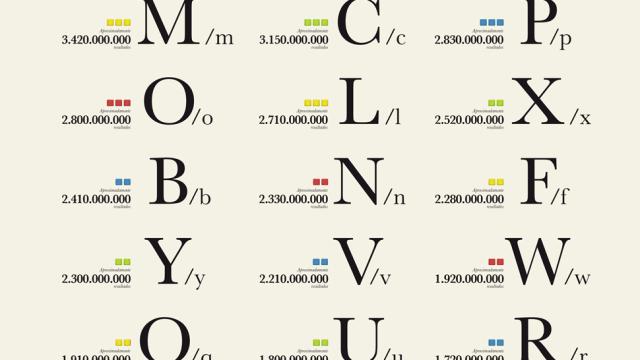
If you had to reorder the alphabet according to the popularity of letters in Google, it would be called the alphaiot. Which, actually, has a quite nice ring to it. It will also look like this.
Now, can anybody explain to me why 6 is the most popular number? [Smäll]
OK we need an internet campaign to promote Z and J. I humbly submit the word Zujj – all we have to do is to get that into common usage. Anyone have any ideas?
Letter frequency orders vary slightly depending on source, but one letter frequency order mnemonic for English is “Etaon(a) Ir(i)sh”. The chart above doesn’t even come close to that.
Looking at the poster, I think that the searches was probably done with a non-English version of Google. Different languages have different letter frequencies, and Google tailors results based on the version (and language) of the page you perform the search in.
Moreover, if you just type a letter in google, you’ll get all single occurrences of the letter that is the letter as a word. Therefore it is not surprising that you get many results for “a” which is the indeterminate article and “I” which is the first person pronoun. This has nothing to do with frequencies of letters and nothing to do with popularities of the letters.
IMHO, and thinking on the number of results per letter, the popularity of each one is taken from the letter ‘alone’, not belonging to a word. For me the amazing result in to see the very small difference between the first two letters, and the huge difference between the second and the third (close to x6), while the third to the very last is only about x3.
It’s only like this because of the fact A and I etc are often used on their own whereas E is not. I bet E is still used more times if you include within other words, but a simple google search wouldn’t reflect that.
Samuel
Thursday, January 13, 2011 at 8:38 AMWould be interesting to compare I to I minus words relating to apple products…
Luke
Thursday, January 13, 2011 at 1:20 PMSimilarly how many times was x counted in uses such as sex or even XXX. the alphaiot sucks…
Grant Hawkins
Thursday, January 13, 2011 at 9:19 AMthe devil: 666
Jon
Thursday, January 13, 2011 at 9:39 AMOK we need an internet campaign to promote Z and J.
I humbly submit the word Zujj – all we have to do is to get that into common usage. Anyone have any ideas?
Michael Pengilley
Thursday, January 13, 2011 at 9:52 AMHow did you get alphaiot? Wouldn’t it be the AIS?
StevoTheDevo
Thursday, January 13, 2011 at 10:14 AMalphaIST or alphaISTE more likely…
Grant Hawkins
Thursday, January 13, 2011 at 10:42 AMAlphabet:
A = Alpha
B = Beta
A+B = Alphabet
A= Aplpha
I= Iota
A+I = Alphaiot
It would probably be changed to Alphiot IMO.
Grant Hawkins
Thursday, January 13, 2011 at 10:42 AMlol sorry, the second A is meant to equal Alpha as well
Disco_box
Thursday, January 13, 2011 at 1:24 PMFascinating stuff.
I’m curious and pondering why Q is higher that U. Perhaps its relevant to Iraq and IQ searches?
RM
Friday, January 14, 2011 at 3:19 PMLetter frequency orders vary slightly depending on source, but one letter frequency order mnemonic for English is “Etaon(a) Ir(i)sh”. The chart above doesn’t even come close to that.
Looking at the poster, I think that the searches was probably done with a non-English version of Google. Different languages have different letter frequencies, and Google tailors results based on the version (and language) of the page you perform the search in.
Benjamin
Saturday, January 15, 2011 at 6:01 AMMoreover, if you just type a letter in google, you’ll get all single occurrences of the letter that is the letter as a word. Therefore it is not surprising that you get many results for “a” which is the indeterminate article and “I” which is the first person pronoun. This has nothing to do with frequencies of letters and nothing to do with popularities of the letters.
boc
Thursday, January 13, 2011 at 3:08 PMLooks like it’s time to update the points for each tile in Scrabble.
Mixa
Thursday, January 13, 2011 at 9:05 PMexactly what I was thinking
Mixa
Thursday, January 13, 2011 at 9:06 PMor at the very least…Words with Friends
Bob
Friday, January 14, 2011 at 9:20 PMIMHO, and thinking on the number of results per letter, the popularity of each one is taken from the letter ‘alone’, not belonging to a word. For me the amazing result in to see the very small difference between the first two letters, and the huge difference between the second and the third (close to x6), while the third to the very last is only about x3.
James
Saturday, January 15, 2011 at 5:46 AMIt’s only like this because of the fact A and I etc are often used on their own whereas E is not. I bet E is still used more times if you include within other words, but a simple google search wouldn’t reflect that.
Marco Valtas
Tuesday, January 18, 2011 at 8:18 AMInteresting that the numbers doesn’t follow the Benford’s Law (http://en.wikipedia.org/wiki/Benfords_law).
cas
Tuesday, January 18, 2011 at 10:12 PMhas anyone check the numbers? I put 6 in google.com and I get 16,690,000,000, and I put 1 and get 25,340,000,000