
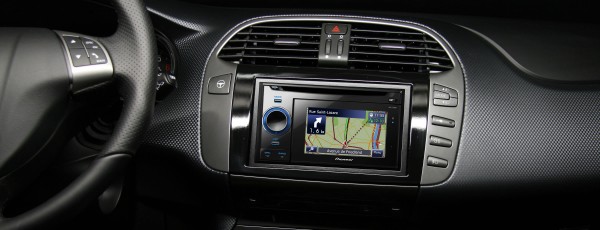
 Pioneer’s just announced their latest AVIC in-dash satnav system, and considering it’s got an RRP of just $1,199, it made me wonder why we aren’t seeing more companies getting behind the in-dash satnav option.
Look at it this way – TomTom’s top-of-the-line Go 930 satnav launched with an RRP of $849. Sure it had maps for the entire world inside, but the Pioneer AVIC system – for just a few hundred dollars extra – adds a proper Bluetooth car kit solution and iPod/iPhone music controls to your car. It includes an AM/FM radio tuner and will also offer you comprehensive reports on your fuel consumption, CO2 emissions and acceleration and brake data.
Sure, you need a car with a couple of spare slots in the dash and you’ll have to pay for installation on top of the hardware, but for the convenience of an all-in-one unit, this is a pretty enticing product.
Pioneer releases a new in-dash multimedia solution with GPS for the car
Celebrating 35 years of world-firsts in both car audio and navigation, Pioneer unveils a new in-dash multimedia solution with advanced GPS for the car. Combining an intuitive 4.3 inch touch screen navigation system with hands-free Bluetooth mobile phone control, MOSFET 50W x 4 amplification power and leading iPod/iPhone connectivity, all at a suggested price of $1,199, Pioneer’s AVIC-F310BT addresses three major concerns of motorists today:
1. How do I navigate to where I want to go?
2. How do I maintain hands-free mobile phone communication whilst driving?
3. How do I continue to listen to and control my music?A sleek, stylish in-dash solution, the AVIC-F310BT not only avoids the dashboard clutter we are now seeing in cars courtesy of portable GPS units, Bluetooth carkits and iPod cables, but also enables navigation, communication and entertainment features to be operated simultaneously and seamlessly.
The AVIC-F310BT builds upon Pioneer’s in-car navigation experience with a powerful processor that offers performance and features beyond those found on typical navigation systems, said Paul Baddeley, product planning at Pioneer Electronics Australia Pty Ltd.”
How do I navigate where I want to go?
Utilising a full-colour 4.3 inch WQVGA detachable touch screen display, 2GB of flash memory and 2D or 3D mapping, the fast and easy-to-use AVIC-F310BT features voice guidance of directions and text-to-speech technology that enables the unit to provide verbal prompts to specific street names.By detaching the screen and connecting it via a USB cable to your PC, users can personalise their AVIC-F310BT, find and add Points of Interest to the maps well as analyse their journeys and driving.
The Pioneer-exclusive AVIC Feeds PC application, enables users to import local information and contacts directly from your computer to the AVIC-F310BT.
Enjoy the flexibility of being able to create your own Point Of Interest’s (POI).
Virtually any location, such as camping grounds, ski resorts, stadiums or tourist destinations, can be created as points of interest. You can simply browse Google Maps or Whereis® mapping and push a search result through to AVIC Feeds, which automatically converts the data into a new POI on the AVIC-F310BT. Create driving reports, particularly useful if you need to calculate your travel expenses in a given period, this application will keep track and provide you with an overview of all the journeys you’ve made and the number of kilometres travelled.You can also see how economically you have been driving. ‘Eco Report’ and ‘fuel consumption’ gives you an evaluation of your acceleration and brake data and also calculates your CO 2 emissions. You can then view a graphical representation of this data on your PC.
How do I maintain hands-free mobile phone communication?
The AVIC-F310BT is equipped with built-in Bluetooth for convenient and safe wireless connection, using a Parrot Bluetooth phone interface. After pairing a compatible Bluetooth enabled cell phone and using the “phone book transfer” function to transfer a cell phone’s contacts/phone-book into the navigation system users can have quick touch-screen access to their contacts/phone-book. All conversations are clearly relayed through your car’s speakers. Three phones can be registered in the system with 400 contacts available per user.How do I listen and control my digital music collection?
The AVIC-F310BT fulfils the high-quality audio and convenience expected from Pioneer with enhanced playback of MP3, WMA and iTunes AAC music files. The USB interface located at the rear of the unit provides a connection to compatible portable media devices including thumb drives, flash memory devices, and iPod/iPhone music players.Music files on compatible iPods/iPhones can be accessed quickly using various methods including:
• Alphabetical Speed Search – users can scroll through their music lists by the first letter in the name.
• Link Search – users can recall similar content to what is currently playing by artist, album and genre.
• Passenger Control – allows passengers to directly control the iPod/iPhone device.The AVIC-F310BT fits into a large number of vehicles with a 2-DIN dash opening, and with 32,768 customisable illumination colours available users can find a colour match for virtually any interior. The unit is also loaded with Pioneer’s legendary Supertuner IIID AM/FM tuner,
two RCA pre-outs, a built-in 50 watt X 4 high-power amplifier and an auxiliary input.The AVIC-F310BT will be available in August 09 for a suggested price of $1,199.